Snow Resources · October 12, 2026 · SnowRemoval.tv editorial team
First Frost: Is Your Ice-Control Plan Ready for New Concrete?
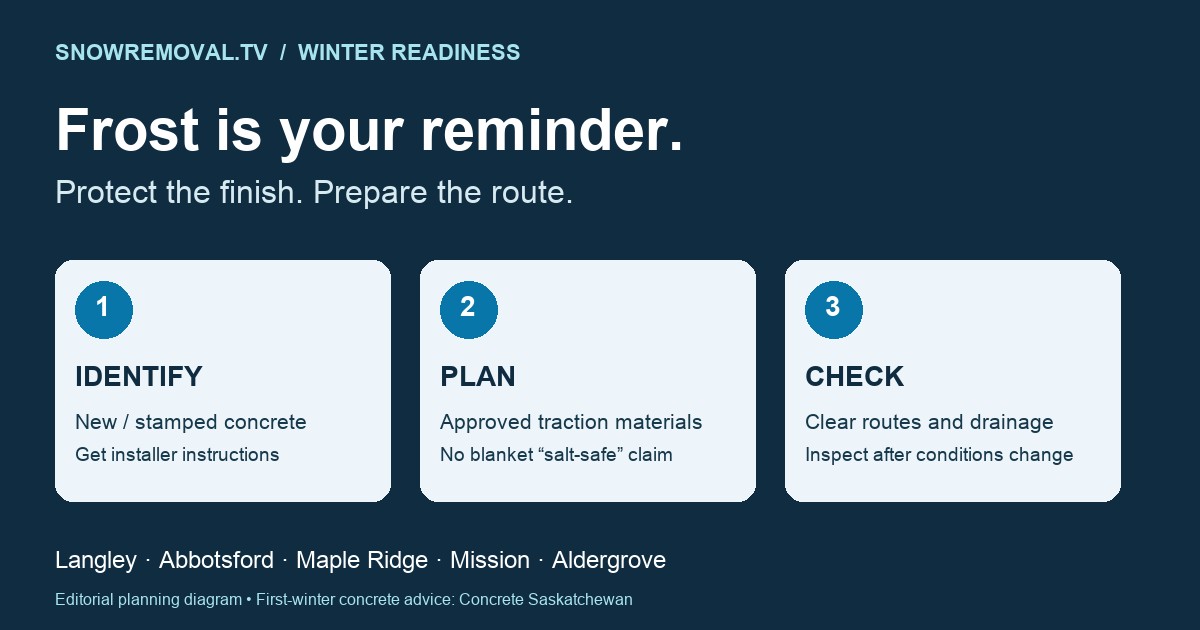
Frost is the reminder to prepare, even before snowfall
A frosty morning is a useful prompt to check the entrances, walkways and supplies you will rely on through winter. You do not need a snowstorm before a damp path becomes a concern. For property owners in Langley, Abbotsford, Maple Ridge, Mission and Aldergrove, the practical question is simple: have you arranged ice control, and does the plan suit every surface on your property? This is a seasonal readiness reminder, not a claim that every Fraser Valley neighbourhood experienced frost today.
New building? Identify the concrete before buying ice melt
A new building may include several different exterior finishes: recently poured sidewalks, older drive lanes, stamped entrance pads and sealed decorative steps. Record the pour dates, finish types, sealer products and the installer’s care instructions. Concrete that looks finished is not automatically ready for routine deicer use. Concrete Saskatchewan recommends keeping deicing chemicals off new concrete during its first winter and considering sand for traction instead. Ask the installer to confirm the plan for your particular slab.
“Concrete-safe” is not a blanket approval
Do not select a bag solely because the label says concrete-safe, pet-friendly or environmentally friendly. Identify its ingredients, application directions, operating range and restrictions, then compare them with the concrete and sealer manufacturer’s instructions. A product suitable for one mature pavement may be inappropriate for a new or decorative surface. Nor does switching from rock salt to a different chloride establish that the replacement is suitable. Keep the actual product label with your winter plan.
Stamped concrete needs its own instructions
Protect both the surface texture and its coating. A stamped pad should not be treated as interchangeable with asphalt. Obtain the installer’s advice on deicers, traction materials, clearing tools and any sealer maintenance. Do not assume that applying more sealer makes unrestricted salt use acceptable. A documented stamped-concrete care manual is linked below as an example; your own installer and product instructions govern the actual finish.
Stock supplies for the approved plan
Secure the supplies your property plan calls for before demand rises, including an appropriate traction material for surfaces where deicer is restricted. Keep products dry, labelled and accessible to the people responsible for treatment. Use separate labelled containers where different surfaces require different materials. Sand can help traction, but it does not melt ice; it needs inspection and replenishment as conditions change, and excess material should be swept up when conditions permit.
Clear, inspect and deal with repeat wet spots
Remove loose snow using methods appropriate to the finish, avoid damaging the surface with aggressive scraping, and check for water draining across paths. Flag downspouts, low spots and shaded entrance areas for review. If a route remains unsafe, arrange a safer access route and contact the responsible manager or contractor instead of leaving people to cross it. A one-time application is not a substitute for checks after rain, meltwater or refreezing.
Get the property details together
For a site discussion in Langley, Abbotsford, Maple Ridge, Mission and Aldergrove, prepare the address, photographs, surface ages, installer restrictions, priority walking routes and requested service scope. Ask who checks conditions between snowfall events and what follow-up visits include. Confirm availability before relying on a booking. Use the PlowWow enquiry link below, and read Snowplow.tv’s separate route-preparation guide if vehicle clearing is also part of your plan.