SnowRemoval.TV / PRACTICAL GUIDE
Should You Hire a Pro to Remove Snow From Your Roof?
When roof snow is a job for a professional, what a good crew does differently, and how to check insurance and WorkSafeBC coverage before they climb.
 SnowRemoval.TV
Hire a qualified professional when roof snow or ice needs assessment or removal beyond what can be evaluated safely without approaching the hazard. Do not climb onto a snowy roof, improvise access or assume a particular snow depth proves the structure is safe. Signs of possible structural distress, active leakage, blocked building outlets or falling snow and ice require prompt assessment by the appropriate qualified service. If you suspect an immediate collapse risk, keep people away and contact emergency services from a safe location.
A roof-snow contractor, roofer and structural professional may have different roles. The first question is whether removal is needed and who is qualified to determine the scope. This guide helps homeowners and property managers make that hiring decision. It does not provide roof-clearing instructions, structural load calculations or a universal removal threshold.
Start with the problem, not a shovel
Describe what prompted the concern. Is there a leak, unusual accumulation, an overhead hazard at an entrance or an advisory from the building's maintenance provider? Those are different situations. A photograph taken from an already safe location can help a professional understand the call, but do not move under a loaded eave or climb for a better view.
CAA-Québec's roof-snow guidance explains that removal is not automatically necessary during ordinary winter conditions. That does not establish that your roof is safe. It means the decision should reflect the building and conditions rather than a blanket instruction to clear every roof after every snowfall.
For a Lower Mainland property, avoid both extremes: assuming snow always melts harmlessly, or treating every accumulation as a structural emergency. Tell the professional what you actually observe and what is unknown. A credible assessment can recommend monitoring, investigation or specialist work without promising that a remote photo answers every question.
Snow depth alone is not a load assessment
Snow can differ in density, distribution and water content. Drifting and accumulation around roof features can make a simple depth comparison misleading. Existing structural condition and the building's design also matter. A homeowner cannot establish capacity from a ruler, a neighbour's roof or a number copied from an article about another climate.
The Ontario government alert on snow loading and roof failures discusses snow accumulation and roof distress as matters requiring a safe response. It is a useful general safety reference, not a statement of BC design requirements. Use a qualified local structural professional when capacity or distress is in question.
Do not convert a forecast into an invented roof-load calculation. A predicted snowfall amount is not a measurement of the material on your roof, and an online calculator does not know hidden deterioration or structural changes. If a professional needs plans, previous inspection records or information about alterations, provide those rather than filling gaps with guesses.
Treat possible distress as a different category
Unusual sagging, new cracking, unfamiliar structural noises or sudden changes in doors and windows can warrant urgent professional attention. No individual symptom proves a cause, but an article should not encourage an owner to investigate beneath a potentially failing roof. If there is immediate danger, leave the affected area and contact emergency services from safety.
Explain the observations plainly: when the change appeared, where it is and whether people are currently exposed. Avoid entering a roof space or another restricted area to diagnose it yourself. A contractor offering routine clearing should not be asked to substitute for structural assessment where the concern is whether the building can safely support people or work.
The response may involve emergency personnel, a structural professional, the building owner and a specialized contractor. Let the competent parties determine the sequence. Speed matters in an urgent situation, but rushing an unassessed crew onto the surface can add another hazard instead of resolving the first one.
Distinguish ice dams, leaks and falling ice
A leak near an eave may involve an ice-related problem, but roof details, flashing and other defects can also matter. A snow-removal booking should not be represented as a guaranteed repair for a leak that has not been diagnosed. Describe where water appears and ask whether a roofing assessment is needed alongside any removal work.
Falling ice and sliding snow create a hazard below the roof even when the interior seems normal. Entrances, walkways and parking areas may need access management by the responsible owner or manager. Do not stand under the affected edge to inspect it or ask a worker to clear above people using the route.
Ventilation, drains and appliance exhausts require appropriate assessment when obstruction is suspected. Do not improvise methods, disturb gas equipment or use an online article to diagnose combustion safety. Contact the relevant qualified provider or emergency service when warranted. The snow contractor should explain which building-system tasks are within its competence and which need another trade.
Ask whether the contractor actually does roof work
A driveway-clearing company does not automatically have the training, systems, insurance or experience for a roof. Ask specifically about the type of roof and work proposed. The answer should identify who will assess the job, who will carry it out and whether subcontractors are involved. An attractive truck sign is not evidence of roof-work capability.
Ask for references relevant to comparable work without treating another customer's project as proof that your building is identical. A contractor can explain its experience while still acknowledging uncertainty about your roof. Be cautious when someone offers a firm diagnosis or a guaranteed outcome before obtaining the information needed for the assessment.
If the company says a roofer or engineer is required first, that is a meaningful scope boundary, not necessarily a delay to negotiate away. Arrange the appropriate review. The objective is a suitable response to the building problem, not simply finding someone prepared to begin immediately.
Verify insurance and WorkSafeBC standing separately
For BC work, check the relevant contractor's registration and standing through WorkSafeBC's clearance process. WorkSafeBC recommends obtaining clearance before and after subcontracted services. Its letter concerns registration and premium payments; it does not certify roof expertise, safe methods or workmanship.
Also request appropriate liability-insurance evidence and confirm questions about coverage with the insurer or broker as needed. Do not assume a policy covers every activity simply because the business has insurance. The contracting entity, proposed activity and subcontractor arrangements should be identifiable in the documents and work order.
Keep the evidence with the dated quote and service record. A clearance letter or certificate obtained for a different business is not proof about the contractor attending your property. Ask for clarification when names differ rather than silently accepting a document because its logo looks familiar.
Ask about the safety plan without designing it yourself
WorkSafeBC's fall-protection guidance explains that planning, supervision and training accompany appropriate protective systems. An owner should ask how the contractor will assess and control hazards, not attempt to prescribe a harness arrangement from a general article. Equipment alone is not a complete work plan.
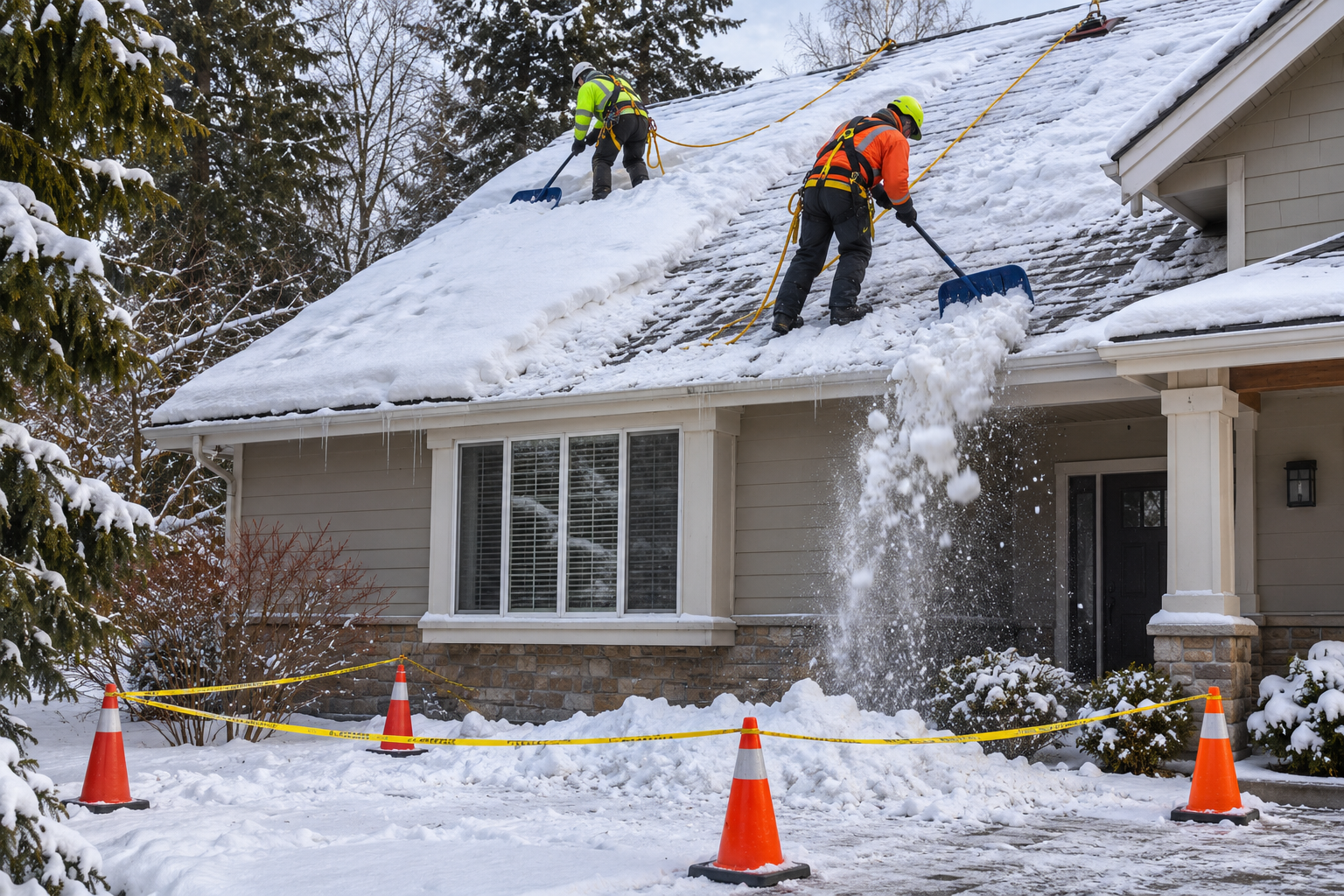
Discuss safe access, protection of occupants and passersby, communication and what would cause the work to stop. Ask who manages the area below and how access changes will be coordinated with the building. A professional should be able to explain the arrangement at a useful customer level while retaining responsibility for the technical method.
This guide does not recommend ladders, rooftop routes, anchor locations, tools or removal patterns. Those decisions depend on the assessed building, conditions and qualified work planning. Do not pressure the contractor to omit safeguards in exchange for a lower price or a faster start.
Get a written scope that matches the actual concern
The quote should name the property, the area to be assessed or serviced, the intended outcome and important exclusions. Distinguish investigation from removal and removal from roof repair. If the work may reveal damage or require another trade, explain how findings and additional approval will be handled before the appointment.
Specify how the contractor will communicate a condition that prevents safe work. A booked visit should not force work to proceed when conditions or the building assessment make it unsuitable. Likewise, a cancelled removal should not leave the owner unsure whether an overhead hazard remains. The report should identify the unresolved concern and the appropriate next contact.
Avoid a promise that all snow will be removed to a bare surface. The appropriate method and extent belong to the qualified assessment and roof requirements. The customer-facing agreement should describe the approved scope honestly rather than using a cosmetic result as a universal standard.
Plan the area below the work
Ask how entrances, pedestrian routes, vehicles and neighbouring property will be considered. Material removed from above must not create an unplanned hazard below. Identify which responsible party can authorize temporary access changes and communicate them to residents, tenants or visitors. Do not assume the crew can close a shared route without coordination.
Tell the contractor about relevant features such as a concealed walkway, a lower roof, rooftop equipment or a regularly used entrance. Treat this as information for assessment, not a demand that workers clear everything immediately. Unknown or inaccessible areas should remain identified as unknown until the competent person reviews them.
A strata or multi-tenant building may need the manager to coordinate several contacts. Keep residents informed of approved access arrangements and a reporting number. They should not approach the active work area for updates or independently change barriers. The coordinator should handle questions through the agreed channel.
A hypothetical homeowner decision
Imagine a homeowner who notices water near an upstairs window after snow and rain. There is visible accumulation above the area, but no structural assessment. This is an invented example, not a customer case or a diagnosis. The homeowner reports the location and timing, stays away from the affected roof edge and contacts a qualified roofing provider.
The roofer may determine that further inspection, specialist removal or another service is needed. The owner asks who will perform each task, obtains the relevant documents and agrees on the scope. If conditions prevent safe work, the next action is documented rather than replaced by an improvised DIY attempt.
The useful lesson is the decision sequence. Identify the concern, protect people from exposure, obtain the right expertise and keep the scope clear. It would be misleading to conclude from the same example that every leak needs removal or that a particular number of centimetres always requires a crew.
A hypothetical property-manager decision
Consider an invented mixed-use building where people report falling ice beside a frequently used entrance. The manager's immediate coordination problem concerns pedestrian exposure, not just the quantity of snow. The manager contacts the appropriate qualified provider, arranges access management through the responsible parties and informs occupants of the approved alternative route.
Before work, the contractor confirms the assessment and planned controls. Afterward, its report identifies the area serviced and any condition needing further investigation. The manager does not announce that the entire property is permanently safe on the strength of one completed visit. New observations remain reportable through a named contact.
This example also distinguishes roof work from ground clearing. A separate driveway or sidewalk agreement may not include overhead hazards at all. Check the actual contracts so the manager does not assume one contractor is monitoring an area that nobody has agreed to assess.
Keep useful records after the visit
Retain the quote, authorizations, insurance and clearance evidence, service date and report. Ask for an understandable description of work completed and any unresolved findings. Photographs should show the actual property and occasion; they should not imply that uninspected areas were checked or that the contractor has certified structural capacity.
If damage or leakage is discovered, document the observation and follow the appropriate insurer, building-owner and professional process. Do not assume either that removal caused it or that existing snow explains it. A factual record supports the investigation better than a confident guess about causation.
For planned maintenance, use the report to arrange appropriate roof, drainage or building-system follow-up before the next event. The required provider and timing depend on the finding. A snow service visit is not a substitute for correcting a roof defect or completing a recommended structural review.
Prepare contacts before the next weather event
Keep the building's roofing contact, property manager, insurer details and relevant service records accessible. Confirm which provider accepts roof-related enquiries and what information it needs. This preparation reduces confusion without requiring a homeowner to buy equipment or attempt roof work.
A qualified professional is worthwhile when the problem needs expertise, safe access and coordinated protection that the owner cannot establish. The decision should rest on the assessed building and observed concern. No photograph, depth rule or general blog post can replace that assessment or justify entering an area where collapse or falling material may be imminent.
Make the first enquiry specific without entering a hazard
When arranging assessment, provide the address, building use, approximate storeys, roof information already in your records and a description of the concern. Say whether occupants or visitors currently use the affected area. If you do not know the roof covering or structure, say unknown. The provider can explain what information is needed without asking you to climb or investigate an unsafe area.
Explain what has already happened: an observed leak, a previous service visit, a reported noise or an access closure. Distinguish your own observation from something another person reported. This helps the professional decide the appropriate response and prevents a tentative description from becoming an invented diagnosis in the work order.
If the property is rented or managed, notify the responsible owner or manager through the established process. Clarify who can authorize assessment and who coordinates access, while treating immediate danger as an emergency rather than waiting for an ordinary maintenance reply. Keep the same factual information available for each qualified provider so a change of contractor does not erase an unresolved concern.
Frequently asked questions
Does a certain snow depth mean my roof must be cleared?
No universal depth proves safety or the need for removal. Snow characteristics, distribution, building design and condition require appropriate professional assessment.
Should I climb onto the roof to inspect the snow?
Do not climb onto a snowy roof or approach falling-material hazards for an inspection. Describe observations from an already safe location and contact the appropriate qualified provider.
What should I ask a roof snow contractor?
Ask about experience with the work, assessment, insurance, WorkSafeBC standing where applicable, safety planning, protection of the area below, written scope and reporting of unresolved findings.
What if I suspect an immediate roof-collapse risk?
Keep people away, leave the affected area and contact emergency services from safety. Do not enter the roof space or send an unassessed crew onto the roof to investigate.